




Lady Augusta Fitz-Clarence1 
F, #105081, b. 17 November 1803, d. 8 December 1865
Last Edited=17 Apr 2017
Lady Augusta Fitz-Clarence was born illegitimately on 17 November 1803 at Busby House, Bushby, Lanarkshire, Scotland.2 She was the daughter of William IV Hanover, King of the United Kingdom and Dorothea Bland.1 She married, firstly, Hon. John Kennedy-Erskine, son of Archibald Kennedy, 1st Marquess of Ailsa and Margaret Erskine, on 5 July 1827.1 She married, secondly, Admiral Lord John Frederick Halyburton, son of George Gordon, 9th Marquess of Huntly and Catherine Cope, on 24 August 1854.1 She died on 8 December 1865 at age 62.3
From 5 July 1827, her married name became Kennedy-Erskine. On 24 May 1831 she was granted the rank of a marquess' daughter.3 From 24 August 1854, her married name became Gordon.
From 5 July 1827, her married name became Kennedy-Erskine. On 24 May 1831 she was granted the rank of a marquess' daughter.3 From 24 August 1854, her married name became Gordon.
Children of Lady Augusta Fitz-Clarence and Hon. John Kennedy-Erskine
- Captain William Henry Kennedy-Erskine+1 b. 1 Jul 1828, d. 15 Sep 1870
- Wilhelmina Kennedy-Erskine+1 b. 27 Jun 1830, d. 9 Oct 1906
- Augusta Millicent Anne Mary Kennedy-Erskine+ b. 11 May 1831, d. 11 Feb 1895
Citations
- [S8] BP1999 volume 1, page 42. See link for full details for this source. Hereinafter cited as. [S8]
- [S6] G.E. Cokayne; with Vicary Gibbs, H.A. Doubleday, Geoffrey H. White, Duncan Warrand and Lord Howard de Walden, editors, The Complete Peerage of England, Scotland, Ireland, Great Britain and the United Kingdom, Extant, Extinct or Dormant, new ed., 13 volumes in 14 (1910-1959; reprint in 6 volumes, Gloucester, U.K.: Alan Sutton Publishing, 2000), volume I, page 67. Hereinafter cited as The Complete Peerage.
- [S8] BP1999. [S8]
Reverend Lord Augustus Fitz-Clarence1
M, #105082, b. 1 March 1805, d. 14 June 1854
Last Edited=17 Apr 2017
Reverend Lord Augustus Fitz-Clarence was born illegitimately on 1 March 1805 at London, England.1 He was the son of William IV Hanover, King of the United Kingdom and Dorothea Bland.1 He married Sarah Elizabeth Catharine Gordon, daughter of Major Lord Henry Gordon and Louisa Payne, on 2 January 1845.1 He died on 14 June 1854 at age 49.1
On 24 May 1831 he was granted the rank of a marquess' younger son.1 He was the Rector at Maple Durham, Oxfordshire, EnglandG.2
On 24 May 1831 he was granted the rank of a marquess' younger son.1 He was the Rector at Maple Durham, Oxfordshire, EnglandG.2
Children of Reverend Lord Augustus Fitz-Clarence and Sarah Elizabeth Catharine Gordon
- Dorothea Fitz-Clarence+1 b. 27 Oct 1845, d. 15 May 1870
- Eva Fitz-Clarence1 b. 1 Jan 1847, d. 2 Mar 1918
- Beatrix Fitz-Clarence1 b. 1 Jan 1847, d. 18 Mar 1909
- Augustus Fitz-Clarence1 b. 13 Feb 1849, d. 16 Oct 1861
- Henry Edward Fitz-Clarence+1 b. 19 Jan 1853, d. 19 Feb 1930
- Mary Fitz-Clarence1 b. Sep 1854, d. 14 Mar 1858
Lady Amelia Fitz-Clarence1
F, #105083, b. 21 March 1807, d. 2 July 1858
Last Edited=17 Apr 2017
Lady Amelia Fitz-Clarence was born illegitimately on 21 March 1807 at Busby House, Bushby, Lanarkshire, Scotland.2 She was the daughter of William IV Hanover, King of the United Kingdom and Dorothea Bland.1 She married Lucius Bentinck Cary, 10th Viscount of Falkland, son of Captain Charles John Cary, 9th Viscount of Falkland and Christiana Anton, on 27 December 1830.1 She died on 2 July 1858 at age 51 at London, EnglandG.1
From 27 December 1830, her married name became Cary. After her marriage, Lady Amelia Fitz-Clarence was styled as Viscountess Falkland on 27 December 1830. In 1831 she was granted the rank of a daughter of a Marquess.3
From 27 December 1830, her married name became Cary. After her marriage, Lady Amelia Fitz-Clarence was styled as Viscountess Falkland on 27 December 1830. In 1831 she was granted the rank of a daughter of a Marquess.3
Child of Lady Amelia Fitz-Clarence and Lucius Bentinck Cary, 10th Viscount of Falkland
- Lucius William Charles Frederick Cary, Master of Falkland1 b. 24 Nov 1831, d. 6 Aug 1871
Citations
- [S21] L. G. Pine, The New Extinct Peerage 1884-1971: Containing Extinct, Abeyant, Dormant and Suspended Peerages With Genealogies and Arms (London, U.K.: Heraldry Today, 1972), page 153. Hereinafter cited as The New Extinct Peerage.
- [S8] BP1999 volume 2, page 2035. See link for full details for this source. Hereinafter cited as. [S8]
- [S8294] Peter and Roger Powell Beauclerk-Dewar, Right Royal Bastards: The fruits of passion (Wilmington, Delaware: Burkes Peerage & Gentry, 2006), page 102. Hereinafter cited as Right Royal Bastards.
Mary Wyndham1
F, #105084, b. 29 August 1792, d. 3 December 1842
Last Edited=8 May 2017
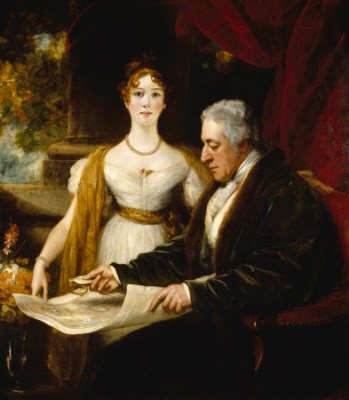
From 18 October 1819, her married name became Fitz-Clarence.3 After her marriage, Mary Wyndham was styled as Countess of Munster on 4 June 1831.
Children of Mary Wyndham and George Augustus Frederick Fitz-Clarence, 1st Earl of Munster
- Lady Adelaide Georgiana Fitz-Clarence6 b. 28 Aug 1820, d. 11 Oct 1883
- Lady Augusta Margaret Fitz-Clarence+6 b. 29 Jul 1822, d. 5 Sep 1846
- William George Fitz-Clarence, 2nd Earl of Munster+3 b. 19 May 1824, d. 30 Apr 1901
- Hon. Frederick Charles George Fitz-Clarence-Hunloke6 b. 1 Feb 1826, d. 17 Dec 1878
- Mary Gertrude Fitz-Clarence6 b. c 1832, d. 1834
- Captain Hon. George Fitz-Clarence+6 b. 15 Apr 1836, d. 24 Mar 1894
- Lt. Hon. Edward Fitz-Clarence6 b. 8 Jul 1837, d. 23 Jul 1855
Citations
- [S11] Alison Weir, Britain's Royal Families: The Complete Genealogy (London, U.K.: The Bodley Head, 1999), page 304. Hereinafter cited as Britain's Royal Families.
- [S3409] Caroline Maubois, "re: Penancoet Family," e-mail message to Darryl Roger Lundy, 2 December 2008. Hereinafter cited as "re: Penancoet Family."
- [S8] BP1999 volume 2, page 2035. See link for full details for this source. Hereinafter cited as. [S8]
- [S130] Wikipedia, online http;//www.wikipedia.org. Hereinafter cited as Wikipedia.
- [S37] BP2003 volume 1, page 1289. See link for full details for this source. Hereinafter cited as. [S37]
- [S8] BP1999. [S8]
stillborn child Hanover1
?, #105085, b. 5 September 1819, d. 5 September 1819
Last Edited=22 Jan 2011
Consanguinity Index=1.29%
stillborn child Hanover was born on 5 September 1819 at Dunkirk, FranceG.1 Stillborn child Hanover was the child of William IV Hanover, King of the United Kingdom and Adelheid Luise Therese Karoline Amelie Prinzessin von Sachsen-Meiningen. Stillborn child Hanover died on 5 September 1819 at Dunkirk, FranceG, stillborn.1
Citations
- [S11] Alison Weir, Britain's Royal Families: The Complete Genealogy (London, U.K.: The Bodley Head, 1999), page 304. Hereinafter cited as Britain's Royal Families.
stillborn child Hanover1
?, #105086, b. 23 April 1822, d. 23 April 1822
Last Edited=22 Jan 2011
Consanguinity Index=1.29%
stillborn child Hanover was born on 23 April 1822 at Bushy Park, London, EnglandG.1 Stillborn child Hanover was the child of William IV Hanover, King of the United Kingdom and Adelheid Luise Therese Karoline Amelie Prinzessin von Sachsen-Meiningen. Stillborn child Hanover died on 23 April 1822 at Bushy Park, London, EnglandG, stillborn.1
Citations
- [S11] Alison Weir, Britain's Royal Families: The Complete Genealogy (London, U.K.: The Bodley Head, 1999), page 304. Hereinafter cited as Britain's Royal Families.
John Carteret, 2nd Earl Granville1
M, #105087, b. 22 April 1690, d. 2 January 1763
Last Edited=20 Dec 2016
Consanguinity Index=0.0%
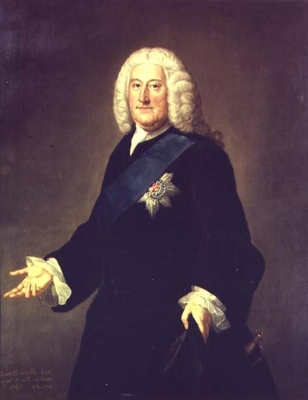
John Carteret, 2nd Earl Granville
by William Hoare, 1743 2
by William Hoare, 1743 2
He succeeded as the 3rd Baronet Carteret, of Metesches, in Jersey [E., 1645] on 22 September 1695.3 He succeeded as the 2nd Baron Carteret of Hawnes, co. Bedford [E., 1681] on 22 September 1695.3 He succeeded as the 2nd Viscount Carteret [G.B., 1715] on 18 October 1744.3 He succeeded as the 2nd Earl Granville [G.B., 1715] on 18 October 1744.8,3 He has an extensive biographical entry in the Dictionary of National Biography.9

Children of John Carteret, 2nd Earl Granville and Frances Worsley
- Lady Grace Carteret+10 b. 8 Jul 1713, d. 23 Jul 1755
- Lady Louisa Carteret+5 b. 1714, d. 25 Dec 1736
- Lady Georgiana Caroline Carteret+11 b. 12 Mar 1715, d. 21 Aug 1780
- George Carteret7 b. 14 Feb 1716
- Lady Frances Carteret+12 b. 6 Apr 1718, d. 25 Dec 1788
- Robert Carteret, 3rd Earl Granville3 b. 21 Sep 1721, d. 13 Feb 1776
Child of John Carteret, 2nd Earl Granville and Lady Sophia Fermor
- Lady Sophia Carteret+13 b. 26 Aug 1745, d. 5 Jan 1771
Citations
- [S6] G.E. Cokayne; with Vicary Gibbs, H.A. Doubleday, Geoffrey H. White, Duncan Warrand and Lord Howard de Walden, editors, The Complete Peerage of England, Scotland, Ireland, Great Britain and the United Kingdom, Extant, Extinct or Dormant, new ed., 13 volumes in 14 (1910-1959; reprint in 6 volumes, Gloucester, U.K.: Alan Sutton Publishing, 2000), volume XII/1, page 153. Hereinafter cited as The Complete Peerage.
- [S3409] Caroline Maubois, "re: Penancoet Family," e-mail message to Darryl Roger Lundy, 2 December 2008. Hereinafter cited as "re: Penancoet Family."
- [S6] Cokayne, and others, The Complete Peerage, volume III, page 68.
- [S6] Cokayne, and others, The Complete Peerage, volume VI, page 89.
- [S6] Cokayne, and others, The Complete Peerage, volume XII/2, page 589.
- [S134] Heraldic Media Ltd., online http://www.cracroftspeerage.co.uk/, Patrick Cracoft-Brennan (Cracroft Peerage Database v5.2), downloaded 1 November 2006.
- [S130] Wikipedia, online http;//www.wikipedia.org. Hereinafter cited as Wikipedia.
- [S8] BP1999 volume 2, page 2673. See link for full details for this source. Hereinafter cited as. [S8]
- [S18] Matthew H.C.G., editor, Dictionary of National Biography on CD-ROM (Oxford, U.K.: Oxford University Press, 1995), Carteret, John. Hereinafter cited as Dictionary of National Biography.
- [S37] BP2003 volume 1, page 1257. See link for full details for this source. Hereinafter cited as. [S37]
- [S6] Cokayne, and others, The Complete Peerage, volume XII/1, pag 153.
- [S37] BP2003. [S37]
- [S6] Cokayne, and others, The Complete Peerage, volume VII, page 437.
Charles Spencer, 3rd Earl of Sunderland
M, #105088, b. circa 1674, d. 19 April 1722
Last Edited=8 Dec 2013
Consanguinity Index=0.03%
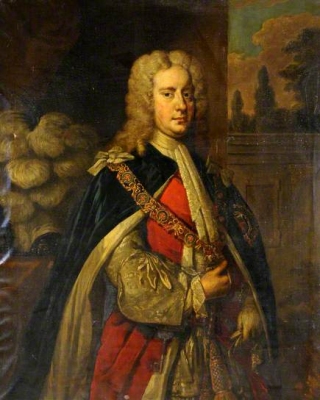
Charles Spencer, 3rd Earl of Sunderland
by Godfrey Kneller 1
by Godfrey Kneller 1
He was styled as Lord Spencer between 1688 and 1702.2 He held the office of Member of Parliament (M.P.) (Whig) for Tiverton from 1695 to 1702.2 He was appointed Fellow, Royal Society (F.R.S.) on 30 November 1698.2 He succeeded as the 3rd Earl of Sunderland [E., 1643] on 28 September 1702.2 He succeeded as the 5th Baron Spencer of Wormleighton [E., 1603] on 28 September 1702. He graduated from Cambridge University, Cambridge, Cambridgeshire, EnglandG, on 16 April 1705 with a Doctor of Laws (LL.D.)2 He held the office of Envoy Extraordinary to Vienna between June 1705 and November 1705.2 He held the office of an English Commissioner for the Union with Scotland in 1706.2 He was appointed Privy Counsellor (P.C.) on 3 December 1706.2 He held the office of Secretary of State for the South from 10 December 1706 to June 1710.2 He held the office of Recorder of Coventry from 1710 to 1722.2 He held the office of Lord-Lieutenant of Ireland on 21 September 1714, although he never went there.2 He held the office of Joint Vice-Treasurer [Ireland] between 1 March 1715 and 16 July 1716.2 He held the office of Lord Privy Seal between 31 August 1715 and December 1716.2 He held the office of Vice-Treasurer [Ireland] between 16 July 1716 and 6 May 1717. He held the office of Secretary of State for the North between 12 April 1717 and March 1718.2 He held the office of Lord President of the Council between 16 March 1718 and February 1719.2 He held the office of First Lord of the Treasury between 21 March 1718 and April 1721, Prime Minister. He resigned in disgrace after the South Seas bubble, in which he was supposed to be involved.2 He held the office of First Gentleman of the Bedchamber between 1719 and 1722. He held the office of a Lord Justice, Regent of the Realm from 1719 to 1720.2 He held the office of Groom of the Stole from 1719 to 1722.3 He was appointed Knight, Order of the Garter (K.G.) on 21 November 1719.3
Cockayne writes, " 'a youth of extraordinary hopes, very learned for his age, and ingenious,' says Evelyn; but says Macaulay, 'the precocious maurity of the young man's intellectual and moral character had excited hopes which were not destined to be realized.2' " Cockayne also writes, "Macky gives him a high character when 'turned 30.' but Swift emphatically put 'no' to the 'virtue' with which he is there credited. He was, says Macaulay, 'a Whig, unhappily for the Whig party, which, before the unhonoured and unlamented close of his life, was more than once brought to the verge of ruin by his violent temper and crooked politics.' According to William, 1st Marquess of Lansdowne, he 'was the most intriguing man that ever existed after his father—whether he was as corrupt or quite as bad a man ... I cannot tell ... [he] was the most passionate man of his time.' His character is sketched not unfavourably by Earl Stanhope."3 Cockayne goes on to quote other views, including "G.M. Trevelyan describes him as 'a true Mœcenas ... In contrast to his unprincipled father, Sunderland was a sincere and straightforward Whig. But he was intemperate and unwise, and not personally popular. Queen Anne dislike him.' It is said that she offered him a life pension of £3,000 p.a. to get rid of him, and he replied that if he could serve his country he would not plunder it. Winston Churchill says that 'he had none of the insinuating charm and genial courtesy of his incomprehensible father. He was an ultra-Whig of the straightest and most unbending type ... He was so conscious of the rights of his order and of Parliament against the Crown that he had little sympathy left for the commonality.3' " "He was from his youth a great collector of books. The 'Sunderland' library formed by him at Sunderland House, and long kept at Blenheim, after it had been pledged to his father-in-law for £10,000, realised nearly £60,000 when broken up, 1882-83."6
Child of Charles Spencer, 3rd Earl of Sunderland and Lady Arabella Cavendish
- Lady Frances Spencer+7 b. c 1696, d. 27 Jul 1742
Children of Charles Spencer, 3rd Earl of Sunderland and Lady Anne Churchill
- Hon. Robert Spencer6 b. 2 Dec 1700, d. 12 Sep 1701
- Robert Spencer, 4th Earl of Sunderland6 b. 24 Oct 1701, d. 15 Sep 1729
- Lady Anne Spencer+8 b. 1702, d. 19 Feb 1769
- Lt.-Gen. Charles Spencer, 3rd Duke of Marlborough+4 b. 22 Nov 1706, d. 20 Oct 1758
- Hon. John Spencer+ b. 13 May 1708, d. 20 Jun 1746
- Lady Diana Spencer+8 b. 1710, d. 27 Sep 1735
Children of Charles Spencer, 3rd Earl of Sunderland and Judith Tichborne
- unnamed child Spencer9 b. a 1718, d. a 1718
- unnamed child Spencer9 b. a 1719, d. a 1719
- Hon. William Spencer8 b. c 1720, d. 17 Apr 1722
Citations
- [S3409] Caroline Maubois, "re: Penancoet Family," e-mail message to Darryl Roger Lundy, 2 December 2008. Hereinafter cited as "re: Penancoet Family."
- [S6] G.E. Cokayne; with Vicary Gibbs, H.A. Doubleday, Geoffrey H. White, Duncan Warrand and Lord Howard de Walden, editors, The Complete Peerage of England, Scotland, Ireland, Great Britain and the United Kingdom, Extant, Extinct or Dormant, new ed., 13 volumes in 14 (1910-1959; reprint in 6 volumes, Gloucester, U.K.: Alan Sutton Publishing, 2000), volume XII/1, page 487. Hereinafter cited as The Complete Peerage.
- [S6] Cokayne, and others, The Complete Peerage, volume XII/1, page 488.
- [S6] Cokayne, and others, The Complete Peerage, volume XII/1, page 153.
- [S8] BP1999 volume 2, page 1867, says 14 Sep 1699. See link for full details for this source. Hereinafter cited as. [S8]
- [S6] Cokayne, and others, The Complete Peerage, volume XII/1, page 489.
- [S37] BP2003 See link for full details for this source. Hereinafter cited as. [S37]
- [S9] Charles Kidd and David Williamson, editor, DeBretts Peerage and Baronetage (London, U.K.: DeBrett's Peerage, 1999), volume 12, page 1871. Hereinafter cited as DeBretts Peerage, 1999.
- [S10] John Pearson, Blood Royal: The Story of the Spencers and the Royals (London, U.K.: HarperCollins, 1999), pages 67. Hereinafter cited as Blood Royal.
Lt.-Gen. Charles Spencer, 3rd Duke of Marlborough1
M, #105089, b. 22 November 1706, d. 20 October 1758
Last Edited=17 Mar 2013
Consanguinity Index=0.06%
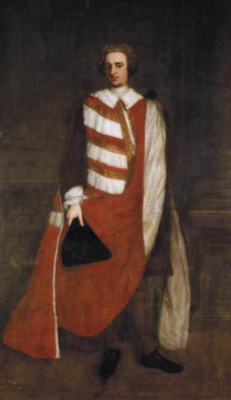
Charles Spencer, 3rd Duke of Marlborough
by Michael Dahl 2
by Michael Dahl 2
 Lt.-Gen. Charles Spencer, 3rd Duke of Marlborough was born on 22 November 1706.3 He was the son of Charles Spencer, 3rd Earl of Sunderland and Lady Anne Churchill.1 He married Hon. Elizabeth Trevor, daughter of Thomas Trevor, 2nd Baron Trevor of Bromham and Elizabeth Burrell, on 23 May 1732.4 He died on 20 October 1758 at age 51 a fever.4,5 He was buried on 21 November 1758 at Chapel, Blenheim Palace, Woodstock, Oxfordshire, EnglandG.4 His will was proven (by probate) on 22 November 1758.6
He was educated circa 1722 at Eton College, Windsor, Berkshire, EnglandG.3 He succeeded as the 7th Baron Spencer of Wormleighton [E., 1603] on 15 September 1729.4 He succeeded as the 5th Earl of Sunderland [E., 1643] on 15 September 1729.7 He held the office of High Steward of St. Albans in 1731. He succeeded as the 3rd Earl of Marlborough, co. Wilts [E., 1689] on 24 October 1733. He succeeded as the 3rd Duke of Marlborough [E., 1702] on 24 October 1733.7 He succeeded as the 3rd Marquess of Blandford [E., 1702] on 24 October 1733. He succeeded as the 3rd Baron Churchill of Sandridge, co. Hertford [E., 1685] on 24 October 1733. He gained the rank of Colonel in 1738 in the 38th Foot.4 He held the office of Lord-Lieutenant of Buckinghamshire between 1738 and 1758. He held the office of Lord of the Bedchamber (Whig) from 1738 to 1743.4 He held the office of Lord-Lieutenant of Oxfordshire from 1738 to 1758.4 He was appointed Knight, Order of the Garter (K.G.) on 20 March 1740/41. He gained the rank of Brigadier-General in 1743.4 He fought in the Battle of Dettingen on 27 June 1743 at Dettingen, GermanyG, where he distinguished himself.4 He was appointed Fellow, Royal Society (F.R.S.) on 12 January 1743/44.4 He gained the rank of Major General in 1745.4 He was awarded the honorary degree of Doctor of Civil Laws (D.C.L.) by Oxford University, Oxford, Oxfordshire, EnglandG, on 4 June 1746.4 He held the office of Lord Steward of the Household from 1749 to 1755.4 He was appointed Privy Counsellor (P.C.) on 12 June 1749.4 He held the office of Master General of the Ordnance from 1755 to 1758.4 He held the office of Lord Privy Seal from January 1755 to December 1755.4 He gained the rank of Lieutenant-General in 1758.4 He fought in the expedition against Cherbourg and St. Malo from May 1758 to August 1758, as Commander in Chief.4 His last will was dated 7 May 1758.
According to Walpole, he "had virtues and sense enough to deserve esteem, but always lost it by forfeiting repsect. He was honest and generous, capable of giving the most judicious advice and of following the worst."4 The 1st Marquess of Lansdowne states he was "an easy, good-natured, gallant man, who took a strange fancy for serving, to get rids of the [ITA:]ennui attending a private life, without any military experience or the common habits of a man of business, or indeed capacity for either, and no force of character whatever."4 Gibbs goes on to state that "if the above accounts be at all fair, it seems almost incredible that any Ministry should have deliberately entrusted the lives and fortunes of their countrymen to such a man supported by a second in command as Lord George Sackville!"4
Children of Lt.-Gen. Charles Spencer, 3rd Duke of Marlborough and Hon. Elizabeth Trevor
- Lady Diana Spencer+8 b. 1734, d. 1 Aug 1808
- Lady Elizabeth Spencer+8 b. 29 Dec 1737, d. 30 Apr 1831
- George Spencer, 4th Duke of Marlborough+6 b. 26 Jan 1738/39, d. 29 Jan 1817
- Lord Charles Spencer+8 b. 31 Mar 1740, d. 16 Jun 1820
Citations
- [S6] G.E. Cokayne; with Vicary Gibbs, H.A. Doubleday, Geoffrey H. White, Duncan Warrand and Lord Howard de Walden, editors, The Complete Peerage of England, Scotland, Ireland, Great Britain and the United Kingdom, Extant, Extinct or Dormant, new ed., 13 volumes in 14 (1910-1959; reprint in 6 volumes, Gloucester, U.K.: Alan Sutton Publishing, 2000), volume XII/1, page 153. Hereinafter cited as The Complete Peerage.
- [S3409] Caroline Maubois, "re: Penancoet Family," e-mail message to Darryl Roger Lundy, 2 December 2008. Hereinafter cited as "re: Penancoet Family."
- [S6] Cokayne, and others, The Complete Peerage, volume XII/1, page 489.
- [S6] Cokayne, and others, The Complete Peerage, volume VIII, page 499.
- [S8] BP1999 volume 2, page 1868, says 28 Oct not 20 Oct. See link for full details for this source. Hereinafter cited as. [S8]
- [S6] Cokayne, and others, The Complete Peerage, volume VIII, page 500.
- [S6] Cokayne, and others, The Complete Peerage, volume XII/1, page 153 and 489.
- [S8] BP1999. [S8]
Edith Elizabeth Fermor-Hesketh1
F, #105090, d. 27 December 1931
Last Edited=11 Mar 2012
Consanguinity Index=0.0%
Edith Elizabeth Fermor-Hesketh was the daughter of Sir Thomas George Fermor-Hesketh, 5th Bt. and Lady Anna Maria Isabella Fermor.1 She married Lawrence Rawstorne on 10 August 1871.1 She died on 27 December 1931.1
From 10 August 1871, her married name became Rawstorne.1
From 10 August 1871, her married name became Rawstorne.1
Citations
- [S37] BP2003 volume 2, page 1894. See link for full details for this source. Hereinafter cited as. [S37]
